
What is a Vector?
Video explanation
Explanation
A vector is a mathematical concept that has both magnitude (size or length) and direction. Unlike scalar numbers, which only have magnitude, vectors represent quantities that are oriented in space. This makes them extremely useful for describing various physical phenomena, such as forces, velocities, and displacements.
BASICS OF VECTORS
A vector is usually represented by a directed line segment (an arrow). The starting point of the segment represents the vector's origin (or initial point), and the endpoint (with the arrowhead) represents its tip (or terminal point). The length of the line segment represents the magnitude of the vector, and the orientation of the segment (indicated by the arrowhead) represents its direction.
NOTATION OF A VECTOR
Vectors can be written in several ways. One common method is by using coordinates, where each coordinate represents the component of the vector in a specific direction. For example, in a two-dimensional space, a vector v can be written as v = (x, y), where x represents the component in the horizontal direction, and y represents the component in the vertical direction.
OPERATIONS WITH VECTORS
Various operations can be performed with vectors, such as addition, scalar multiplication, and the scalar (or dot) product.
- VECTOR ADDITION is performed component-wise (e.g., (x₁, y₁) + (x₂, y₂) = (x₁ + x₂, y₁ + y₂)). Geometrically, it can be represented by the parallelogram law or the head-to-tail method.
- SCALAR MULTIPLICATION means multiplying a vector by a number (a scalar), which changes its magnitude (and can reverse its direction if the scalar is negative) but not its fundamental direction.
- The SCALAR PRODUCT (or dot product) of two vectors results in a scalar value, which, among other things, can indicate if the two vectors are perpendicular (if their dot product is zero).
IMPORTANCE OF VECTORS
Vectors are indispensable in mathematics as they allow for a precise description of the direction and magnitude of various quantities. By understanding vectors, we can better analyze and comprehend the motion of objects, the forces acting upon them, and other spatial interactions.
CONCLUSION
A vector is a fundamental concept that enables students to delve deeper into understanding mathematical and physical phenomena involving direction and magnitude. Their universal applicability and ability to accurately describe dynamic systems make vectors one of the key tools in scientific and other disciplines. Understanding vectors opens doors to numerous possibilities for analysis, modeling, and problem-solving across a wide spectrum of fields.
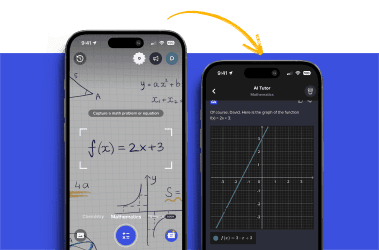


Take a picture of your assignment and use AI tutor.
What is a Vector?