
Vectors
2 chapters
Vectors are mathematical objects defined by magnitude and direction and are used to represent quantities that have direction in addition to magnitude, such as velocity, force, or displacement. In mathematics, they play a key role by providing a tool for describing motion and forces in space and enabling complex calculations.
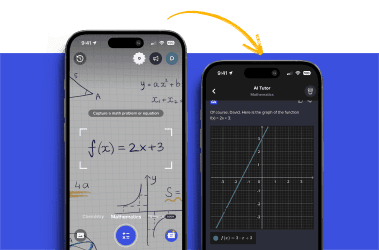


Take a picture of your assignment and use AI tutor.
Definition of a Vector
1 video
What is a Vector?

Scalar Product (Dot Product)
What is a Scalar Product (Dot Product)?
INTRODUCTION TO VECTORS
Vectors are one of the fundamental concepts of linear algebra and mathematics in general, allowing for the quantitative treatment of direction and magnitude. They are key to understanding spatial relationships, dynamics, and numerous other mathematical and physical concepts. Vectors enable students to accurately model and analyze movements, forces, and other vector quantities.
DEFINITION AND PROPERTIES OF VECTORS
A vector is a mathematical object that has two main characteristics: magnitude (or length) and direction. Vectors can be represented graphically as arrows, where the length of the arrow represents the magnitude of the vector, and the arrowhead indicates its direction. In mathematical notation, vectors are often denoted by lowercase letters with an arrow above them (e.g., v⃗) or in bold (e.g., v).
- DIMENSION OF A VECTOR: This is determined by the number of components of the vector, which corresponds to the dimension of the space in which the vector lies (e.g., a 2D vector has two components, a 3D vector has three).
- OPERATIONS WITH VECTORS: These include addition, subtraction, scalar multiplication (multiplying a vector by a number/scalar), and the vector product (or cross product). (The dot product or scalar product is another important operation). These operations allow for the construction of complex mathematical models and analysis.
USES OF VECTORS
Vectors have wide application in various scientific and technical disciplines:
- PHYSICS: They are used to describe the direction and magnitude of physical quantities such as forces, velocities, and accelerations.
- COMPUTER GRAPHICS: Vector graphics use vector models to represent images, allowing for unlimited scaling without loss of quality.
- ENGINEERING: Vector analysis is key in the design and analysis of mechanical systems, electromagnetic fields, and other engineering applications.
- MATHEMATICS: Vectors are the basis for the development of vector spaces and matrices, which are crucial for linear algebra and many other mathematical disciplines.
CONCLUSION
Vectors are essential for understanding and applying mathematical principles in practice. Their ability to combine direction and magnitude into a single mathematical object allows for the elegant modeling and analysis of many natural and technical phenomena. Knowledge and understanding of vectors open the door to a better comprehension of the world around us and are an indispensable tool in science and technology.