
Trigonometry
2 chapters
Trigonometry is the branch of mathematics that studies the relationships between angles and sides of triangles. It focuses on the definition and use of trigonometric functions to solve geometric problems.
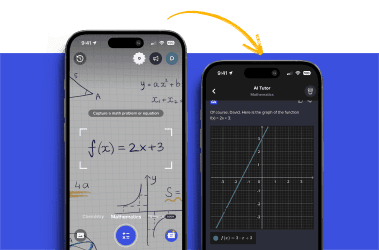


Take a picture of your assignment and use AI tutor.
Trigonometric Functions
9 videos
What is Trigonometry?

Trigonometric Functions - Basics
Trigonometric Functions – Example
Relationships between Trigonometric Functions (Trigonometric Identities)
What are Sine and Cosine?
Table of Trigonometric Functions
Finding the Value of an Angle with Trigonometric Functions - Exercise 2
Simplifying Expressions with Trigonometric Functions 1
Simplifying Expressions with Trigonometric Functions 2
Graph – Sine and Cosine
2 videos
Graph of the Sine Function
Graphing Tutorial 1 (Graph - Sine and Cosine)
INTRODUCTION TO TRIGONOMETRY
Trigonometry is a branch of mathematics that focuses on the study of angles and the relationships between the sides of triangles. It originates from the Greek words "trigonon" (triangle) and "metron" (measure). Its utility ranges from pure mathematics to practical applications in physics, engineering, and other scientific disciplines. It explores the basic trigonometric functions – sine, cosine, and tangent – which are key for analyzing periodic phenomena and solving problems involving triangles.
BASICS OF TRIGONOMETRY: TRIGONOMETRIC FUNCTIONS AND RIGHT-ANGLED TRIANGLES
Trigonometry studies the properties and applications of trigonometric functions such as sine, cosine, and tangent, which are crucial for analyzing and solving problems related to triangles, especially right-angled ones.
TRIGONOMETRIC FUNCTIONS
These are functions that determine the ratio between the sides of a right-angled triangle and its angles. These include sine (sin), cosine (cos), tangent (tan), and cotangent (cot).
RIGHT-ANGLED TRIANGLES
The foundation of trigonometry, where trigonometric functions connect angles with the sides of a triangle. Each function (sin, cos, tan) has a specific geometric interpretation and mathematical relationship between angles and sides. The fundamental problem of trigonometry is solving a triangle. This means calculating the sizes of angles and the lengths of segments, sides, and heights in a triangle.
APPLICATIONS
Trigonometry finds its utility in numerous fields, ranging from theoretical to practical applications.
- PHYSICS: It is used to understand phenomena such as waves, optics, and mechanics, where forces and the motion of bodies are analyzed.
- ENGINEERING: It is the foundation for the design and analysis of structures, mechanisms, and electrical circuits, where trigonometric functions are key for determining forces, moments, and other physical quantities.
- ASTRONOMY: It enables the calculation of the positions of celestial bodies, distances in space, and navigation by the stars.
CONCLUSION
Trigonometry is a key pillar of mathematics, providing fundamental tools for understanding and manipulating geometric and physical phenomena through angles and ratios. Its versatility and utility across a wide spectrum of scientific and engineering disciplines reflect its importance and indispensability in modern education and professional practice. Understanding trigonometry opens doors to a better comprehension of the world around us and allows for solving complex problems with a simple approach to the analysis of triangles and circles.