
Functions
8 chapters
Functions in mathematics are fundamental concepts that relate two variables in such a way that each value of one variable (the independent variable) is assigned a specific value of the other variable (the dependent variable). Functions are the foundation for expressing mathematical relationships.
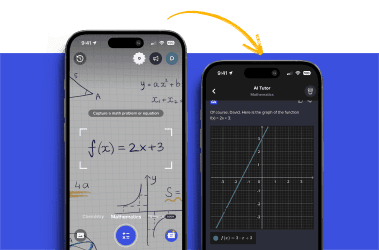


Take a picture of your assignment and use AI tutor.
Function
4 videos
What is a Function?

Zeros of a Function and Initial Value
Injective and Surjective Functions
Triangle Perimeter and Area
Linear Function
6 videos
What is a Linear Function?
Graph of a Linear Function
Difference Quotient
Zero of a Linear Function
Explicit Equation of a Line (Slope-Intercept Form)
Intersection of Lines
Quadratic Function
5 videos
Quadratic Function – Introduction
Quadratic Function – Vertex
Quadratic Function – Zeros
Quadratic Function – Example
Factoring Quadratic Equations 1
Inverse Function
1 video
Inverse Function - Explanation
Power Function
What is a Power Function?
Exponential Function
What is an Exponential Function?
Logarithmic Function
2 videos
What is a Logarithmic Function?
Graph of a Logarithmic Function - Explanation
Exponential Equation
Exponential Equation 1
Exponential Equation 2
UNDERSTANDING FUNCTIONS IN MATHEMATICS
Functions are one of the fundamental concepts in mathematics and describe a specific type of relationship between two sets of numbers or objects. In mathematics, a function is often understood as a "rule" that assigns exactly one value from another set (called the codomain or range) to each value from one set (called the domain).
FUNCTION BASICS
One can imagine a function as a machine that, when you input a number (the input), performs an operation and outputs a new number (the output). This "rule" or operation, which determines how an input value is transformed into an output value, is written mathematically as f(x), where x is the input value and f represents the rule of the function.
PROPERTIES OF A FUNCTION
Every function has a domain, which is the set of all possible input values, and a codomain, which is the set of all possible output values. Importantly, the function assigns exactly one value from the codomain to each value from thedomain. This is the fundamental property of a function that distinguishes it from other mathematical relationships.
There are many different types of functions, depending on their form and properties. Basic types include the linear function, which has a constant slope and is represented as a straight line; the quadratic function, which is represented as a parabola; and exponential and logarithmic functions, which have specific exponential increases and decreases. Each type of function has its own characteristic properties that determine the shape of its graph.
USES
Functions are centrally important in mathematics and the natural sciences because they allow for the modeling and understanding of various natural and social phenomena. They are used to describe relationships between quantities, analyze changes, and predict outcomes in various contexts.
CONCLUSION
Understanding functions is crucial for anyone working in mathematics. Knowledge of functions enables students to solve problems, analyze data, and develop a deeper understanding of the world around them.