
What Are Variations?
Video explanation
Explanation
DEFINITION AND BASICS
In mathematics, variations represent one of the basic concepts of combinatorics, which deals with the different ways of selecting and arranging elements. This concept is crucial for solving problems involving the arrangement of objects, selection, and ordering.
A variation is an ordered selection of ‘r’ elements from a group of ‘n’ distinct elements. The important distinction is that order matters, which separates variations from combinations. Variations can appear in two forms: variations without repetition and variations with repetition.
- Variations without Repetition: Here, each element from the group is chosen at most once. The number of variations without repetition of ‘n’ elements, taking ‘r’ at a time, is given by: V(n, r) = n! / (n - r)!
- Variations with Repetition: In this case, the same element can be chosen multiple times. The number of such variations is: n^r where ‘n’ is the number of elements to choose from, and ‘r’ is the number of selections made.
EXAMPLES AND USES
Variations are useful in different situations where a precise arrangement is important. For example, when determining how many different numerical codes can be created from 10 digits if each code contains 4 different digits, we use the formula for variations without repetition. They are also important in computer science, cryptography, and various mathematical puzzles.
CONCLUSION
Understanding variations is fundamental for students and professionals dealing with combinatorics and related fields. This concept allows for a better understanding of how different choices and arrangements affect problem solutions and how the number of possible outcomes can dramatically increase with the addition or removal of constraints in the selection and ordering of elements.
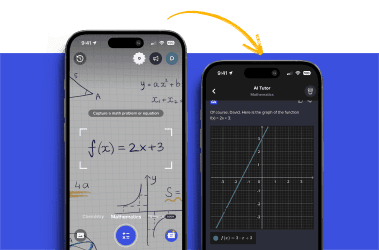


Take a picture of your assignment and use AI tutor.
What Are Variations? Variations with Repetition