
What Are Permutations?
Video explanation
Explanation
INTRODUCTION TO PERMUTATIONS
Permutations are a mathematical concept dealing with the different ways a set of elements can be arranged or ordered. This concept is very important in combinatorics, a branch of mathematics focused on counting, ordering, and structuring. For example, if you think about arranging three books on a shelf, the various ways you line them up are the permutations of those books.
BASIC EXPLANATION OF PERMUTATIONS
A permutation is any possible ordered arrangement of a group of distinct elements. The key here is that order matters. For instance, if we have three distinct elements A, B, and C, the possible permutations are ABC, ACB, BAC, BCA, CAB, and CBA.
The number of all possible permutations of a group of elements can be calculated with a formula based on the number of elements. If you have n distinct elements, the number of all possible permutations is n! (n-factorial), which is the product of all whole numbers from 1 to n (e.g., 4! = 4 * 3 * 2 * 1 = 24).
PERMUTATIONS WITH REPETITION
Permutations can also apply to cases where some elements are repeated. In such a scenario, the formula for calculating permutations accounts for this repetition. For example, if we have the elements A, A, and B, the number of distinct permutations is smaller because the two A's are identical.
PRACTICAL APPLICATIONS
Permutations are used in various practical contexts, such as:
- Arranging people, objects, or numbers in a specific order.
- Solving puzzles and problems that involve ordering.
- In computer science for algorithms that involve different arrangement or selection options.
- In statistics and probability for analyzing the possible outcomes of events.
CONCLUSION
Permutations are a fundamental concept in combinatorics that allow mathematicians and scientists to accurately calculate the number of possible arrangements. Understanding this concept is important for students and professionals in mathematics, computer science, statistics, and other related disciplines. These techniques are key to solving complex problems in many scientific and practical applications, from developing software algorithms to understanding complex biological patterns.
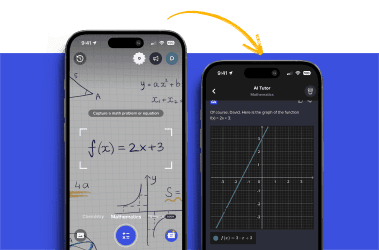


Take a picture of your assignment and use AI tutor.
- The Fundamental Counting Principle
- Permutations
- Variations in Combinatorics
- Combinations