
What are Combinations?
Video explanation
Explanation
INTRODUCING COMBINATIONS IN MATHEMATICS
Combinations are a crucial concept in mathematics, especially in areas like combinatorics, probability theory, and statistics. When we explain combinations, we need to focus on selecting elements from a specific set where the order of the selected elements doesn't matter.
DEFINITION AND CORE CONCEPTS OF COMBINATIONS
Combinations involve choosing some or all elements from a given set. So, if we have a set with 'n' elements and we choose 'r' elements from this set, provided that the number of these elements is greater than or equal to zero and does not exceed the total number of elements in the set (0≤r≤n), the number of all possible combinations is determined by the formula:
C(n,r)=n!/[r!∗(n−r)!]
Here, 'n!' represents the factorial of the number n, which is the product of all positive integers up to n.
EXAMPLE: UNDERSTANDING THE COMBINATIONS FORMULA
Let's look at an example to better understand the formula: Suppose we have a group of 5 people and we want to choose 3 of them to perform a specific task. We calculate the number of all possible combinations of people we can choose as C(5,3). This is calculated as:
C(5,3)=5!/[3!∗(5−3)!] =5!/[3!∗2!] =(5∗4∗3∗2∗1)/[(3∗2∗1)∗(2∗1)] =120/(6∗2) =120/12 =10
So, there are 10 different ways to choose 3 people from a group of five.
THE IMPORTANCE OF DISTINGUISHING BETWEEN COMBINATIONS AND PERMUTATIONS
Combinations differ from permutations because, with permutations, the order of selecting elements is very important, whereas in combinations, it's not. For example, if we choose people A, B, and C, it's the same as if we had chosen the people in the order B, C, and A. In permutations, however, these would be counted as different selections.
APPLICATIONS OF COMBINATIONS
Combinations are widely used in various mathematical and practical applications:
- In statistics, they're crucial for calculating the probability of events where the order isn't important.
- They're also significant in graph theory, where combinations of connections between nodes are analyzed.
- Think of lotteries, where the numbers drawn form a combination, as the order of selection doesn't matter for winning.
- They're used when forming teams, committees, or groups where every member is equal and their position isn't specified.
CONCLUSION: MASTERING COMBINATORIAL SELECTIONS
To sum it up, combinations are a fundamental mathematical concept that allows us to understand and analyze situations where the selection of elements is important, but their order isn't considered. Grasping this concept provides deeper insights into various mathematical and real-world problems.
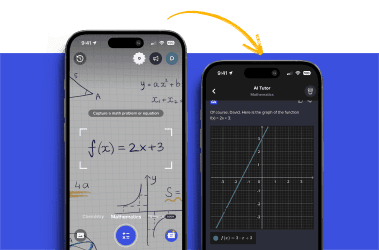


Take a picture of your assignment and use AI tutor.
What are Combinations?