The best AI for physics: pick by topic, then check the answer
The best AI for physics depends on your topic and level: a step-by-step tutor to set up the problem, a calculator to check the number, a simulation to see what should happen. We compare Astra AI, Wolfram|Alpha, PhET, ChatGPT study mode and Khanmigo from their own pages, then give you seven physics checks to run on any AI answer.
The short answer
There is no single best AI for physics. The best AI for physics homework is the one that matches your topic and level, and whose answer survives a few physics checks. A tool that is great at crunching a lens equation can still get the direction of a magnetic force wrong. So pick by topic first, then check every answer before you copy anything into your notebook.
This guide gives you both: a quick route by topic and level, short notes on five tools, and seven checks you can run on any AI answer, whichever tool wrote it.
How we chose
We looked at what each tool says about itself on its own website or help center, checked on 9 October 2026. We did not run a test with scores, and there is no ranking here. The tools are grouped by the job they do. Prices and plans change and can differ by country, so treat them as a snapshot.
Astra AI is our product. It is in the list under the same rules as the others, with its downsides.
Pick by topic and level
Mechanics: forces, motion and projectiles
This is where most homework lives: blocks on ramps, cars braking, balls thrown off cliffs. The physics is usually not hard. The mistakes come from a missing force, a sign that flips halfway through, or a component taken with sine instead of cosine.
- Use a tutor that makes you draw the free-body diagram and set an axis before any equation.
- Use PhET's free Forces and Motion: Basics or Projectile Motion simulation when you want to see what the numbers mean.
- Use Wolfram|Alpha to double-check a final number once your own setup is right.
Circuits, electricity and magnetism
Before Ohm's law, someone has to decide what is in series and what is in parallel. That step is easy to get wrong, for you and for an AI. Magnetic forces add a second trap: the direction comes from a cross product or a right-hand rule, and a sentence like "the force points up" means nothing without axes.
- Build the circuit in PhET's Circuit Construction Kit: DC and see if the current matches your answer.
- When you use any chatbot, ask it to name the series and parallel parts before it calculates.
- Do right-hand-rule directions yourself, with your hand, and compare.
Waves and optics
Wave speed, frequency and wavelength, lenses and mirrors, refraction. Most questions are one or two formulas, but the sign rules for lenses differ between textbooks, so a correct-looking answer can still use a convention your teacher doesn't.
- PhET's Wave on a String and Bending Light simulations are good for building intuition.
- Wolfram|Alpha has worked examples for the thin lens equation and diffraction.
- Tell the AI which sign convention your class uses.
Modern physics and calculus-based university courses
Photon energy, relativity and early quantum topics at school, or calculus-based mechanics and electromagnetism at university. At this level the algebra gets longer, so skipped steps hide more mistakes. Ask for the derivation in symbols first and plug in numbers last. If your course is algebra-based, say so, or you may get an answer full of integrals you were never taught.
Five tools, what each is good for
Astra AI (our product)
Astra AI's AI physics tutor works through a problem you type or photograph, step by step, from motion and energy to force. Its physics page says you can practise on questions about what you are learning now, that every answer is marked, and that you see where a step went wrong. Not sure about a step? You can ask a follow-up and it tries a different explanation. Its homepage says it adapts from middle school through university. For a test date, Exam Prep builds a topic by topic plan from your notes, slides, past papers or photos, with quizzes and timed or oral mock exams.
Free vs paid: you can start free, no card required. Astra AI Plus unlocks unlimited tutoring, mock exams and podcasts. Astra AI Plus prices are shown on the upgrade page and vary by country.
Honest limit: our own page for parents says AI can make mistakes, so don't treat every response as automatically correct. The seven checks below apply to Astra's answers too.
Wolfram|Alpha
Wolfram|Alpha says it knows a variety of physical formulas and constants, with examples across mechanics, optics, waves, thermodynamics, relativity and quantum physics. Its step-by-step solutions cover math, chemistry and physics problems from elementary school to college.
Free vs paid: the free Basic account does not include step-by-step solutions. Wolfram|Alpha Pro for Students lists $9.99 a month billed monthly, or $5.00 a month billed annually ($60.00 a year). Prices in USD, checked 9 October 2026.
Honest limit: it computes; it does not ask you what you think. It is best for checking a number or a formula once you have set the problem up yourself.
PhET Interactive Simulations
PhET, from the University of Colorado, describes its simulations as fun, free, interactive and research-based. They run online or can be downloaded. For physics homework, Projectile Motion, Forces and Motion: Basics, Circuit Construction Kit: DC, Wave on a String and Bending Light cover a lot of school topics.
Free vs paid: the simulations are free for students and teachers.
Honest limit: PhET is not AI and it will not solve your worksheet. It shows you what should happen, which is exactly what you need to judge an AI's answer.
ChatGPT study mode
OpenAI's help center says study mode is available across ChatGPT plans, on web, iOS and Android. Instead of only giving a final answer, it can ask questions, guide your thinking, explain step by step and check your understanding. You can upload a photo of a science problem.
Free vs paid: study mode uses the same limits as the ChatGPT plan you are on.
Honest limit: OpenAI says study mode can make mistakes and may sometimes give a direct answer. Ask for hints if you want to do the thinking yourself.
Khanmigo (Khan Academy)
Khan Academy says Khanmigo doesn't just tell you the answer; it guides you to find it, and it helps with almost any academic subject, including science. For learners and parents it costs $4 a month or $44 a year (USD, sales tax not included, checked 9 October 2026).
Honest limit: to get Khanmigo as a learner or parent, you must be 18 or older, live in the United States and have a US billing address. If you are under 18, a parent or guardian has to sign up and add you to their account. It is a general tutor, not a physics specialist.
Seven checks to run on any AI answer
These come from the mistakes physics teachers see every week. Use them on any tool's answer, including ours.
- Units and dimensions. Every line should carry units, and the final unit must make sense. For v = √(2gh), the units are √(m/s² × m) = m/s. That is a speed, so the formula at least has the right shape.
- A free-body diagram before any force equation. For a block sliding down a 30° ramp with friction coefficient 0.2, the answer should list weight, normal force and friction before writing F = ma. Then a = g(sin 30° - 0.2 × cos 30°) = 9.81 × (0.5 - 0.173) ≈ 3.2 m/s². If friction or the normal force is missing, stop there.
- A stated axis and sign convention. A ball rolls off a 20 m cliff at 5 m/s. Choose down as positive, and it lands after t = √(2h/g) = √(40/9.81) ≈ 2.0 s, about 10 m from the base. An answer that mixes "up is positive" with g = +9.81 m/s² will give nonsense.
- Vector direction. For a launch at 20 m/s and 30° above the horizontal, the horizontal part is 20 × cos 30° ≈ 17.3 m/s and the vertical part is 20 × sin 30° = 10 m/s. For magnetic forces, the answer must say which way the force points and why: a proton moving along +x in a field along +z feels a force along -y.
- Circuit layout before Ohm's law. A 6 Ω and a 3 Ω resistor in parallel make 2 Ω, not 9 Ω. A quick check: a parallel combination is always smaller than the smallest resistor. On 12 V that is 6 A from the battery, not about 1.3 A.
- Order of magnitude. On the 30° ramp, the acceleration has to be less than g × sin 30° ≈ 4.9 m/s², because friction slows the block down. 3.2 m/s² passes. A thrown ball landing 2 km away does not.
- No skipped algebra. The answer should rearrange in symbols first (from h = ½gt² to t = √(2h/g)) and only then put in numbers. If a number appears out of nowhere, ask where it came from.
Tip Paste this list into the chat and ask the AI to show each check for its own answer. If it can't, treat the answer as a draft, not a solution.
Where AI still trips on physics
A 2026 study in the journal Physics Education, "How well do AI systems solve AP physics?", gave the algebra-based AP Physics 1 and 2 free-response questions from 2015 to 2025 to four widely accessible AI systems: ChatGPT 4.1 mini, Gemini 2.5 Flash, Claude 4.0 Sonnet and DeepSeek R1. Three physics experts graded the answers with the official College Board scoring guidelines. The average scores were fairly high, between 82% and 92% depending on the model and the exam. But the authors found the same kinds of mistakes in all four: misreading diagrams and graphs, drawing graphs wrong, reasoning wrongly about vector direction, circuit topology errors, partial or misleading explanations, and trouble with three-dimensional ideas like the right-hand rule. Those were exam questions and specific model versions, so the scores are a snapshot, not a grade for every chatbot today.
The mistakes match the checks above. To get better answers:
- Describe the diagram in words: what is connected to what, which way each arrow points, where the axis is.
- Give every number with its unit.
- Say your level: algebra-based school physics or calculus-based university physics.
- Ask for the setup first and the numbers last.
Where Astra AI fits
Astra AI is our product, so read this part with that in mind. It fits when you want to be walked through a problem step by step, ask "why?" as many times as you need, and then practise on similar questions that get marked. It also fits when a physics test has a date and you want a plan built from your own notes through Exam Prep.
It is not the right pick if you only need a quick number check (Wolfram|Alpha is built for that) or if you want to play with a setup and watch what happens (that is PhET's job). Our homepage says Astra can replace a private tutor for most students. Most, not all: if you keep getting stuck on the same step after a few weeks, a human teacher or tutor is the better next step.
Quick recap
- Pick the tool by topic and level: a tutor for setting up problems, a calculator for checking numbers, a simulation for intuition.
- Run the seven checks on every answer: units, free-body diagram, axis and signs, vector direction, circuit layout, order of magnitude, no skipped algebra.
- Describe diagrams in words and give units when you ask.
For the same approach in other subjects, see the best AI for chemistry, the best AI math tutor or the general guide to the best AI tutor. Test tomorrow? Read how to study the night before an exam.
Frequently asked questions
There isn't one best AI for physics. Match the tool to the job: a step-by-step tutor such as Astra AI (our product), ChatGPT study mode or Khanmigo when you need to understand the setup, Wolfram|Alpha when you want to check a number or formula, and PhET simulations when you want to see what should happen. Then check the answer for units, a free-body diagram, a clear sign convention and the right vector directions.
Often, but not always. A 2026 study in Physics Education gave four widely accessible AI systems the algebra-based AP Physics 1 and 2 free-response questions from 2015 to 2025. Their average scores ranged from 82% to 92%, yet all four kept making the same kinds of mistakes: misreading diagrams and graphs, wrong vector directions, circuit layout errors and trouble with the right-hand rule. Treat any AI answer as a draft until it passes your own checks.
Yes, with limits. ChatGPT study mode is available across ChatGPT plans, within the limits of your plan. Astra AI lets you start free with no card, and Astra AI Plus unlocks unlimited tutoring. Wolfram|Alpha's free Basic account does not include step-by-step solutions. PhET simulations are free but are not AI.
Use a solver to check a final number once your own setup is right. Use a tutor when you don't yet know how to start, because physics tests grade the setup: the diagram, the axis, the equation you chose and the units. If you only copy solutions, the next problem on the test will feel brand new.
- Astra AI Physics (checked 9 Oct 2026)
- Astra AI home and FAQ (checked 9 Oct 2026)
- Astra AI for parents: AI can make mistakes (checked 9 Oct 2026)
- Wolfram|Alpha examples: Physics (checked 9 Oct 2026)
- Wolfram|Alpha examples: Step-by-step solutions (checked 9 Oct 2026)
- Wolfram|Alpha Pro for Students pricing (checked 9 Oct 2026)
- About PhET Interactive Simulations (checked 9 Oct 2026)
- PhET simulation: Projectile Motion (checked 9 Oct 2026)
- PhET simulation: Circuit Construction Kit: DC (checked 9 Oct 2026)
- OpenAI Help Center: Using study mode in ChatGPT (checked 9 Oct 2026)
- Khanmigo for learners: pricing and eligibility (checked 9 Oct 2026)
- How well do AI systems solve AP physics? Physics Education, 2026 (abstract)
- Same study on arXiv, submitted 8 Mar 2026 (abstract)
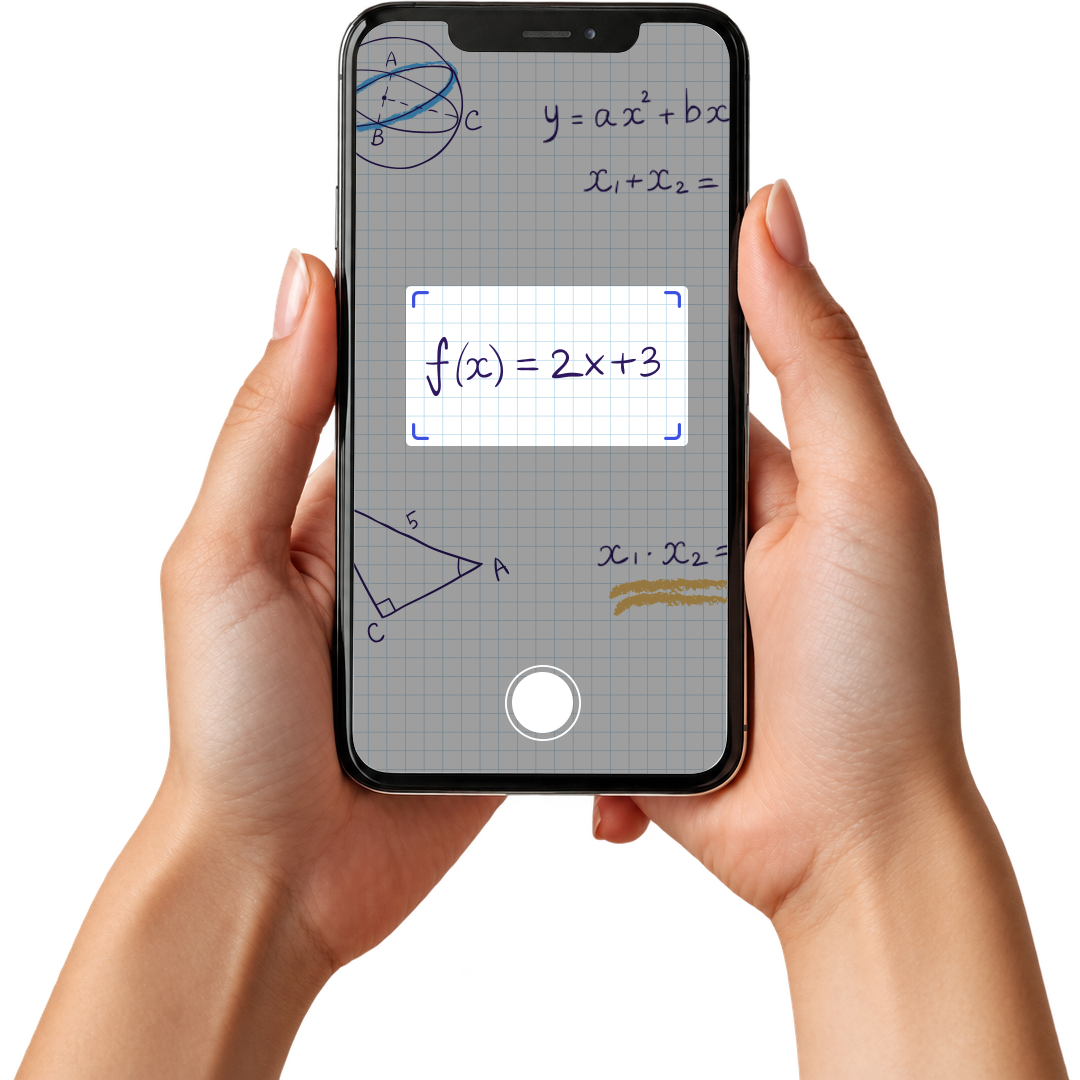
Stuck on a problem? Just scan it.
Snap a photo of any question and the AI Tutor walks you through it step by step, until it actually clicks.